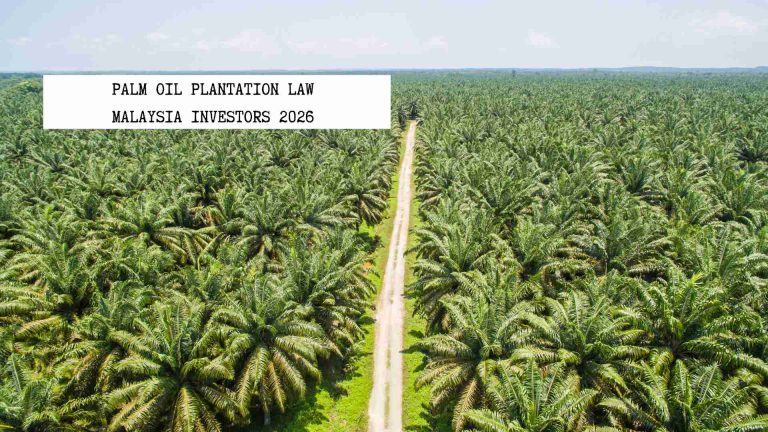
In early 2026, a major Malaysian plantation group faced an unprecedented legal challenge when the Indonesian Attorney General’s Office (AGO) identified their 15,000-hectare estate in Riau as overlapping with “Forest Zone” (Kawasan Hutan) boundaries. Despite holding a valid HGU for over a decade, the company faced potential asset seizure under the government’s 2026 crackdown on illegal land occupation. For Malaysian investors, who manage a significant portion of Indonesia’s 17 million hectares of palm oil, the risk is no longer just operational efficiency it is the absolute validity of their Right to Cultivate (HGU).
The HGU Validity Crisis and Forest Zone Overlaps
The primary legal instrument for plantation land in Indonesia is the Right to Cultivate, governed by Undang-Undang Nomor 5 Tahun 1960 tentang Peraturan Dasar Pokok-Pokok Agraria (selanjutnya disebut UUPA) dan Undang-Undang Nomor 39 Tahun 2014 tentang Perkebunan (selanjutnya disebut UU Perkebunan).
The critical risk in 2026 arises from the “Syncronization Policy.” The Indonesian government is currently reconciling the One Map Policy with the Ministry of Environment and Forestry’s data. Malaysian firms often find that land traditionally considered “Non-Forest Area” (APL) has been reclassified. Under the UU Perkebunan, a plantation operating without a verified HGU that is free from forest overlaps can be categorized as a criminal offense, leading to the revocation of the Business Identification Number (NIB) and immediate asset seizure.
Mandatory Plasma Schemes: The 20% Compliance Rule
Beyond land titles, the most frequent source of friction between Malaysian firms and the Indonesian government is the “Plasma” obligation. Under the UU Perkebunan and its implementing regulations, plantation companies are required to facilitate the development of community plantations (Plasma) equivalent to at least 20% of the total land area managed by the company.
For Malaysian investors, “Plasma” is often viewed as a social corporate responsibility, but in 2026, it is a strict legal prerequisite for HGU extension. Failure to demonstrate a functional partnership with local cooperatives (Koperasi) is now a primary ground for the Ministry of Agrarian Affairs and Spatial Planning (ATR/BPN) to reject the renewal of land titles, effectively rendering the investment “stateless.”
Strategic Expert Opinion: The Legalinfo Perspective
For Malaysian firms, the key to longevity in Indonesia is shifting from “Legal Defense” to “Social License.”
Menurut Gunawan Sembiring, S.H., Managing Partner Legalinfo Lawyers, Malaysian plantation managers must proactively conduct “Tenurial Audits” before the AGO or Ministry of Forestry initiates an investigation. He notes that in 2026, the Indonesian government is using satellite-based AI to monitor HGU utilization. He emphasizes that Legalinfo Lawyers focuses on the “Clean and Clear” certification of land titles ensuring that every hectare is documented not only in the BPN database but also verified through a “Free, Prior, and Informed Consent” (FPIC) process with local customary (Adat) communities. According to Gunawan, a Malaysian firm with a strong “Social License” is significantly less likely to face administrative targeting during government crackdowns.
2026 Risk Mitigation Protocol for Malaysian Planters
To safeguard your plantation investment, Legalinfo Lawyers recommends the following defensive roadmap:
-
HGU Boundary Verification: Conduct an independent boundary audit against the 2026 “One Map” database to identify any overlaps with protected forest zones before they are flagged by the AGO.
-
Plasma Scheme Restructuring: Ensure your 20% community partnership is not just on paper. Document all profit-sharing and land-utilization activities with local cooperatives to meet UU Perkebunan standards.
-
Customary Rights (Adat) Mapping: Identify and engage with local indigenous communities. Under the 2026 legal landscape, “Customary Rights” (Masyarakat Hukum Adat) are increasingly recognized by the Constitutional Court, and a lack of early engagement can lead to permanent land blockades.
-
Sustainability Alignment: Harmonize your Malaysian Sustainable Palm Oil (MSPO) standards with the Indonesian Sustainable Palm Oil (ISPO) 2026 updates to ensure seamless export capabilities and administrative compliance.
-
Conflict Resolution via Mediation: In the event of a land dispute, utilize formal mediation mechanisms provided by the UU Perkebunan rather than escalating immediately to the District Court, which often favors local community interests in land-grabbing allegations.
Conclusion
The Indonesian palm oil sector in 2026 is undergoing a “Corrective Era.” For Malaysian investors, the transition means that legacy land titles are being scrutinized with 21st-century digital precision. Success requires a dual-track strategy: maintaining a “Clean and Clear” HGU under the UUPA while securing the 20% Plasma obligation under the UU Perkebunan. For Malaysian capital, the safest plantation is the one that is legally transparent and socially integrated.