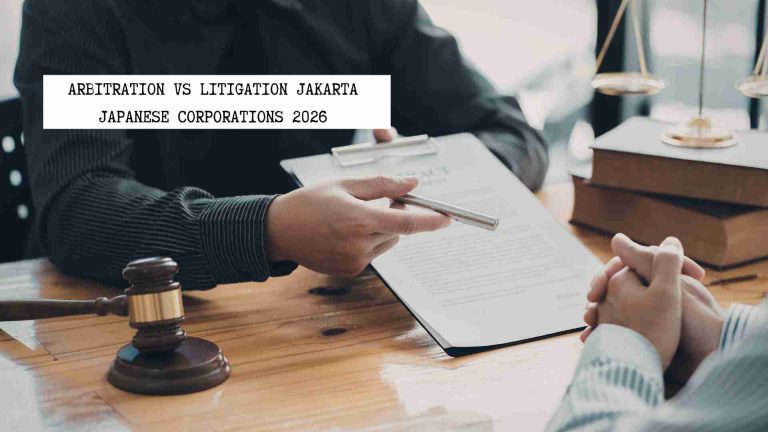
In 2025, a Japanese manufacturing conglomerate involved in a joint venture dispute in Jakarta opted for the District Court system, expecting a resolution based on the clear merits of their contract. Instead, they were trapped in a three-year cycle of appeals, ending at the Supreme Court, while their local partner continued to operate the disputed assets. Conversely, a Japanese trading house in a similar conflict utilized a SIAC arbitration clause, securing an enforceable award in less than 10 months. In 2026, for Japanese firms where “Time is Capital,” the choice of forum is the most critical defensive decision in any Indonesian contract.
The Litigator’s Burden: Public Record and Multi-Tier Appeals
Civil litigation in Indonesia is governed by the Herzien Inlandsch Reglement (hereinafter referred to as the HIR) and Law Number 48 of 2009 concerning Judicial Power (hereinafter referred to as the Judicial Power Law).
The primary risk for Japanese corporations in the court system is the lack of finality. Under the Judicial Power Law, any party has an almost automatic right to appeal to the High Court and subsequently file for Cassation at the Supreme Court. This creates a “litigation loop” that can span 3 to 5 years. Furthermore, Indonesian courts are public; for Japanese firms that prioritize reputational integrity and confidentiality, the public disclosure of sensitive commercial evidence during a trial is often an unacceptable collateral risk.
The Arbitral Advantage: The 2025 BANI Rules and SIAC
The alternative is institutional arbitration, governed by Law Number 30 of 1999 concerning Arbitration and Alternative Dispute Resolution (hereinafter referred to as the Arbitration Law). For Japanese firms, the landscape has significantly improved with the introduction of the 2025 BANI Rules by the Indonesian National Board of Arbitration.
The 2025 BANI Rules now include a “headline innovation”: Emergency Arbitration. This allows Japanese investors to seek urgent interim measures—such as asset freezes or stay orders—before a full tribunal is even formed. When compared to the Singapore International Arbitration Centre (hereinafter referred to as SIAC), BANI offers a more localized execution path, while SIAC remains the gold standard for Japanese firms seeking a neutral, third-country seat with highly predictable costs and timelines.
Strategic Expert Opinion: The Legalinfo Perspective
Choosing between BANI and SIAC depends entirely on the location of the assets and the “Seat” of the arbitration.
According to Gunawan Sembiring, S.H., Managing Partner Legalinfo Lawyers, Japanese corporations should prioritize BANI for domestic-heavy operations but insist on SIAC for cross-border capital injections. He notes that in 2026, the Indonesian Supreme Court has become increasingly “arbitration-friendly,” but enforcement remains a technical hurdle. He emphasizes that Legalinfo Lawyers focuses on the “Exequatur” phase—the process of registering an arbitral award at the Central Jakarta District Court. Without a flawlessly executed Exequatur, even a SIAC award is unenforceable on Indonesian soil, making the choice of local legal counsel just as important as the choice of the arbitral institution.
2026 Decision Matrix: Arbitration or Litigation?
To determine the safest path, Legalinfo Lawyers recommends Japanese firms evaluate these five criteria:
-
Finality: Arbitration awards are “Final and Binding” under the Arbitration Law, with no right to appeal on the merits. Litigation allows for years of appeals.
-
Expertise: In arbitration, Japanese firms can appoint arbitrators with specific technical or industry expertise. In litigation, judges are generalists appointed by the state.
-
Confidentiality: Arbitration is strictly private. Litigation is part of the public record.
-
Cost Predictability: While institutional fees for BANI or SIAC are higher upfront, the total cost is often lower than 5 years of multi-tier litigation.
-
Enforceability: If the counterparty’s assets are strictly in Indonesia, a BANI award is often faster to execute. If the assets are international, SIAC (under the New York Convention) is superior.
Conclusion
For Japanese corporations operating in Jakarta, the “safest” resolution is the one that offers the most control and the least publicity. While the Indonesian judiciary is modernizing, the inherent delays of the Judicial Power Law remain a structural disadvantage for high-stakes B2B disputes. By utilizing the 2025 BANI Rules or SIAC frameworks, Japanese investors can ensure that their disputes are resolved by experts, in private, and with a definitive end date.